Committee report: Assisted Living / Customized Living
Source: Minnesota House Fraud Prevention & State Agency Oversight Committee · original.
Root source: https://www.house.leg.state.mn.us/comm/docs/PBkehwf-FEOo19Pitj0Z8A.pdf#page=57
- What it establishes
- The chapter covers the committee's December 17, 2025 hearing on assisted living facilities (ALFs) that bill Medicaid for customized living services. The committee finds that small single-family homes licensed as ALFs have been used to bypass the moratorium on Community Residential Services, citing a 2022 DHS report and an MDH presentation, and reports that as of September 2025 facilities of six or fewer made up over 82% of Hennepin County ALFs and 97% of new provisional licenses statewide. Testimony showed ALFs are licensed by MDH but enrolled by DHS, and the committee finds that neither agency takes responsibility for financial oversight or Medicaid fraud detection. Chair Robbins presented a map of interconnected providers, businesses and realtors, and the report describes an unnamed owner (Person 1), Jama Mohamod, whom it says is alleged to have defrauded Medicaid through an ICS business, and Gandi Mohamed, a Feeding Our Future defendant whose properties were used by ALFs operated by his wife and associates. The report quotes DHS saying it cannot withhold payment based only on an indicted person being a landlord, which the committee does not find credible, and notes Mohamed pleaded guilty in April 2026 to fraudulently obtaining $1.4 million.
The chapter covers the committee's December 17, 2025 hearing on assisted living facilities (ALFs) that bill Medicaid for customized living services. The committee finds that small single-family homes licensed as ALFs have been used to bypass the moratorium on Community Residential Services, citing a 2022 DHS report and an MDH presentation, and reports that as of September 2025 facilities of six or fewer made up over 82% of Hennepin County ALFs and 97% of new provisional licenses statewide. Testimony showed ALFs are licensed by MDH but enrolled by DHS, and the committee finds that neither agency takes responsibility for financial oversight or Medicaid fraud detection. Chair Robbins presented a map of interconnected providers, businesses and realtors, and the report describes an unnamed owner (Person 1), Jama Mohamod, whom it says is alleged to have defrauded Medicaid through an ICS business, and Gandi Mohamed, a Feeding Our Future defendant whose properties were used by ALFs operated by his wife and associates. The report quotes DHS saying it cannot withhold payment based only on an indicted person being a landlord, which the committee does not find credible, and notes Mohamed pleaded guilty in April 2026 to fraudulently obtaining $1.4 million.
Findings the committee states
- Committee finding: small single-family homes providing assisted living have been used to bypass the licensing moratorium on Community Residential Services, producing many new providers and facilities; a 2022 DHS report flagged rising reimbursements, concentrations of small metro facilities, and the failure of recent legislative action to curb them. p. 57
Small single-family homes providing assisted living services have been used to bypass the licensing moratorium on Community Residential Services (CRS)
- Committee observation: large numbers of single-family homes are being acquired and turned into taxpayer-funded ALFs, in what the committee says appears to be a coordinated effort rather than an organic response to demand. p. 57
The Committee found massive numbers of single-family homes are being acquired and turned into highly profitable taxpayer-funded ALFs.
- Committee finding: split authority between MDH (licensing, biennial safety inspections) and DHS (Medicaid enrollment) leaves no agency responsible for oversight of financial management. p. 59
Segregated authority has created gaps and no one has responsibility for oversight of financial management.
- Per testimony from both agencies as summarized by the report: MDH is not responsible for detecting or preventing Medicaid fraud, and DHS does not conduct financial or records inspections for program integrity. p. 59
the Department of Health is not responsible for detecting or preventing Medicaid fraud
- Committee finding: networks of new small ALFs have grown rapidly in the metro with high reimbursement rates; facilities of six or fewer were over 82% of Hennepin County ALFs and 97% of new provisional licenses statewide as of September 2025. p. 59
Networks of new small Assisted Living Facilities (ALFs) have a exploded in the metro with very high reimbursement rates.
- Committee observation: ownership of many small ALFs connects to other Medicaid-funded entities and to a metro brokerage whose agents repeatedly act as buyers' agents for homes converted to ALFs; examples given are Person 1 and Jama Mohamod (R3). p. 60
connections were observed between many providers and other Medicaid funded entities
- Committee finding: Gandi Mohamed, indicted in the Feeding Our Future case at the time of the hearing, owns properties used by two ALF businesses (1st Attentive Services, run by his wife, and A Caring Living, run by individuals connected to him); three of 1st Attentive Services' four homes are held through GAK Properties, which the report calls the LLC he used for money laundering in the Feeding Our Future case. p. 61
Gandi Mohamed, indicted (at the time of the hearing) in the Feeding Our Future fraud scheme has direct connections to two assisted living businesses.
- The committee rejects DHS's published position that it cannot withhold payments when an indicted person is only a landlord, saying Mohamed bought the properties and has relationships with the operators. p. 62
The Committee does not find this credible. The indicted person clearly had purchased the properties and has relationships with the operators
- Committee summary conclusion: interconnected relationships let known fraudsters, family members and associates keep billing taxpayers, even while facing charges in another case. p. 62
the interconnected web of relationships that enable known fraudsters and their family members and business associates to continue to bilk taxpayers
Figures
| tens of millions of dollars | Committee's characterization (not itemized) of what the ALF fraud vector is costing taxpayers | p. 57 |
| hundreds of thousands of dollars per year for each client | Amount the committee says many recently opened facilities are receiving (paid), per client per year | p. 57 |
| four or fewer | Client threshold of the restriction preventing enrollment of new ALFs serving people on disability waivers | p. 57 |
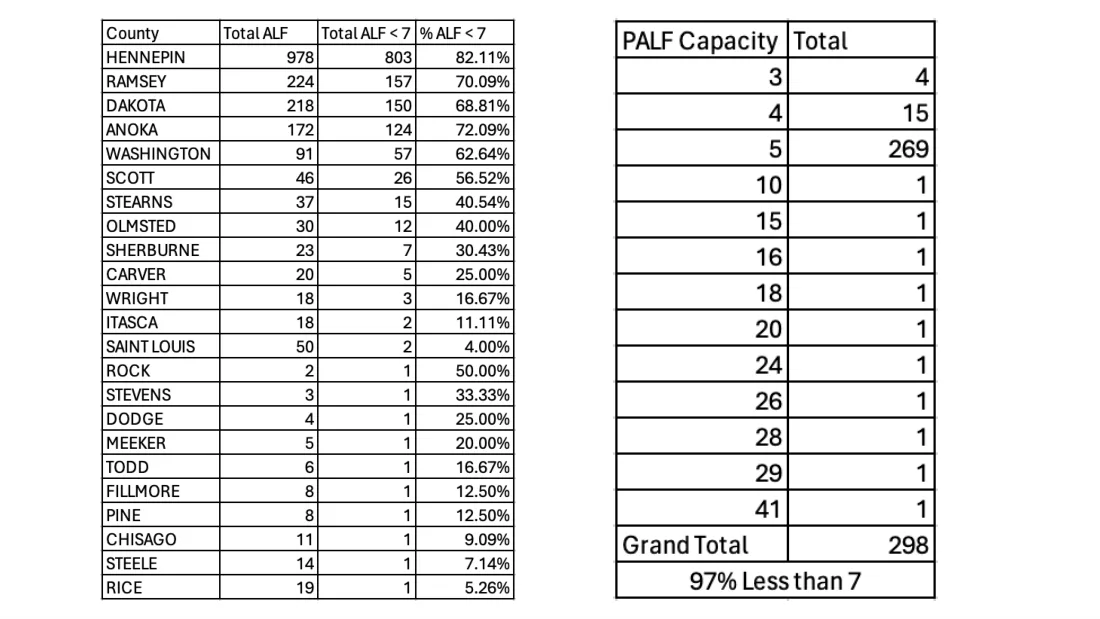
| over 82% | Share of Hennepin County assisted living facilities in homes with capacity of six or less, as of September 2025 | p. 59 |
| 97% | Share of new provisional ALF licenses statewide for capacity of 6 or less, as of September 2025 | p. 59 |
| three | Number of ALFs Jama Mohamod operates under A Helping Hand Senior Care Services | p. 61 |
| over $1 million | Taxpayer funds received (paid) by one of two non-profits founded by Jama Mohamod | p. 61 |
| 4 | Number of properties on which 1st Attentive Services operates; three owned by Gandi Mohamed through GAK Properties | p. 61 |
| $49 million | Appears only in the headline of the cited Minnesota Reformer article (fn. 97): amount DHS paid since 2016 to a man indicted in Feeding Our Future; not stated in the report body | p. 61 |
| $1.4 million | Amount Gandi Mohamed pleaded guilty in April 2026 to fraudulently obtaining; the quoted KARE 11 passage says he was ordered to pay it back | p. 62 |
Witnesses
- Minnesota Department of Health (testifiers not named in report), Agency testimony; committee document 'MDH Presentation on ALFs' p. 58
- Minnesota Department of Human Services (testifiers not named in report), Agency testimony p. 59
Recommendations
- Committee: agencies should focus on finding interconnected webs of relationships and stop payments as soon as red flags appear, rather than waiting until millions have been paid. p. 62
- Committee: stop sending taxpayer dollars to known fraudsters and their associates. p. 62
- DHS (2022 report, not the committee): suggested additional changes the legislature could make to further curb the growth of small providers; the specifics are in a chart not captured in the text. p. 58
What it establishes. Agency testimony established that ALFs are licensed by MDH and enrolled by DHS with neither inspecting finances for program integrity, and that small facilities dominate the sector as of September 2025; the report also documents that properties owned by Feeding Our Future defendant Gandi Mohamed were used by ALFs run by his wife and associates, and that he pleaded guilty in April 2026.
What it does not. The chapter does not show that the ALFs tied to Mohamed, Person 1 or Jama Mohamod billed for services not provided, and does not quantify ALF fraud losses; the 'tens of millions' figure and the coordinated-network description are committee characterizations, the claims about Mohamod are framed as allegations, and Chair Robbins's map is not reproduced in the text.
Related records: Integrated Community Supports · United States v. Bock and others · CACFP / SFSP meal programs · Deena Winter
Source: Assisted Living Slides, House Fraud Committee hearing, Dec 17, 2025 (committee document, as presented by Rep. Robbins) · archival copy
Read this chapter in the searchable report
Full text, pages 57–62
Assisted Living/Customized Living Hearing Date: Wednesday, December 17, 202594
Background:
Another area that demonstrates the interconnected web of fraud is a scheme that leverages the Assisted Living Facilities (ALF) program, funded under the Medicaid Home and Community Based Services (HCBS) program. Traditional HCBS services include skilled nursing care, durable medical equipment, and hospice care.
While there are fraud concerns in those service areas, fraudsters exploited a new ALF program that allows them to purchase small homes and bill for rent and multiple MA services with minimal oversight. Some of these ALF owners or operators are linked to defendants in Feeding Our Future. They apparently took the same playbook into the ALF program, creating another vector of fraud that is costing taxpayers tens of millions of dollars.
The Committee found massive numbers of single-family homes are being acquired and turned into highly profitable taxpayer-funded ALFs. One of the most common tips the Committee received were from residents throughout the metro reporting suspicious group homes suddenly appearing in their neighborhood and seemingly not providing legitimate services. Many of these facilities have been opened in recent years and are receiving hundreds of thousands of dollars per year for each client. Rather than an organic response to demand for these services, the Committee has observed what appears to be coordinated efforts to bring more providers into this space.
Finding: Small single-family homes providing assisted living services have been used to bypass the licensing moratorium on Community Residential Services (CRS), resulting in a large number of new providers and facilities.
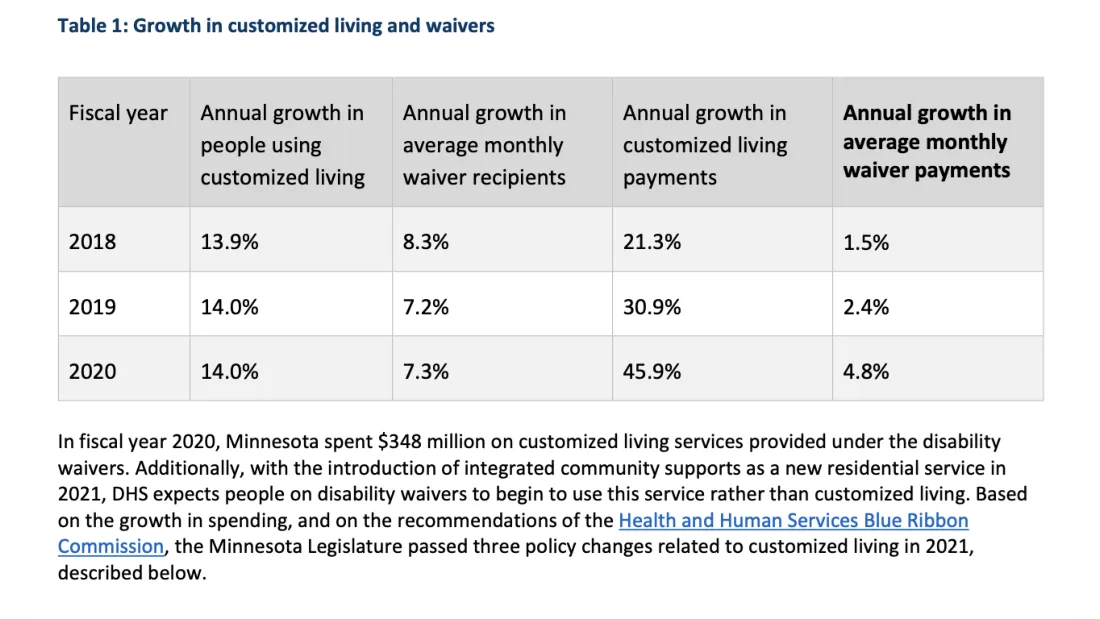
In a 2022 report to the legislature from DHS entitled Controlling the Growth of Customized Living, the agency discussed several concerning trends in the customized living space including:
these small businesses.95
The new restrictions prevented the enrollment of new assisted living facilities serving four or fewer clients on disability waivers, which had become a loophole for providers to bypass the longtime moratorium on new community residential service providers. The moratorium was intended to keep the supply of services in line with the number of people in need of these services.
94 YouTube video, House Fraud Prevention and State Agency Oversight Policy Committee 12/17/25. 95 Minnesota Department of Human Services, Controlling the Growth of Customized Living, Legislative Report, June 2022.
2 source links on this page
While these recent changes steered a number of providers away from the assisted living licensure, the agency suggested additional changes the legislature could make to further curb the growth of these small providers.
Note: From Controlling the Growth of Customized Living.
In 2021, new Assisted Living Facility (ALF) licensure became available through the Department of Health. The initial number of applicants ended up being substantially higher than what the agency estimated, with many home healthcare companies applying for the new licensure as small Assisted Living Facilities. Since then, the number of new settings has continuously grown, with new small facilities comprising the vast majority of the growth.
Note: from “MDH Presentation on ALFs” in the committee documents for the hearing.96
96 12/17/2025 Committee Document “MDH Presentation on ALFs.”
1 source link on this page
Finding: Segregated authority has created gaps and no one has responsibility for oversight of financial management.
Taxpayer funded Assisted Living Facilities (ALFs) operate under the purview of both the Department of Health and the Department of Human Services. These businesses must obtain Assisted Living licensure through the Department of Health (MDH) but must also enroll with the Minnesota Health Care Program through the Department of Human Services (DHS) to deliver Medicaid funded services for clients (“Customized Living”).
The Department of Health conducts biennial inspections of licensed ALFs, but since the agency is not responsible for the service delivery, their inspections are limited to facility safety and health standards, not whether or how well MA services are provided. .
Testimony from both agencies revealed that the Department of Health is not responsible for detecting or preventing Medicaid fraud, and that the Department of Human Services does not conduct financial or records inspections for program integrity purposes.
Finding: Networks of new small Assisted Living Facilities (ALFs) have a exploded in the metro with very high reimbursement rates.
The Committee found an emerging trend in assisted living. Among the existing licensed facilities, the overwhelming majority are in homes with a capacity for six individuals or less. In Hennepin County, these facilities constitute over 82% of the total number of assisted living facilities in the county as of September 2025. Among the new, provisionally licensed facilities, typically within their first year of operation, 97% of these licenses across the entire state were for a capacity of 6 or less as of September 2025.
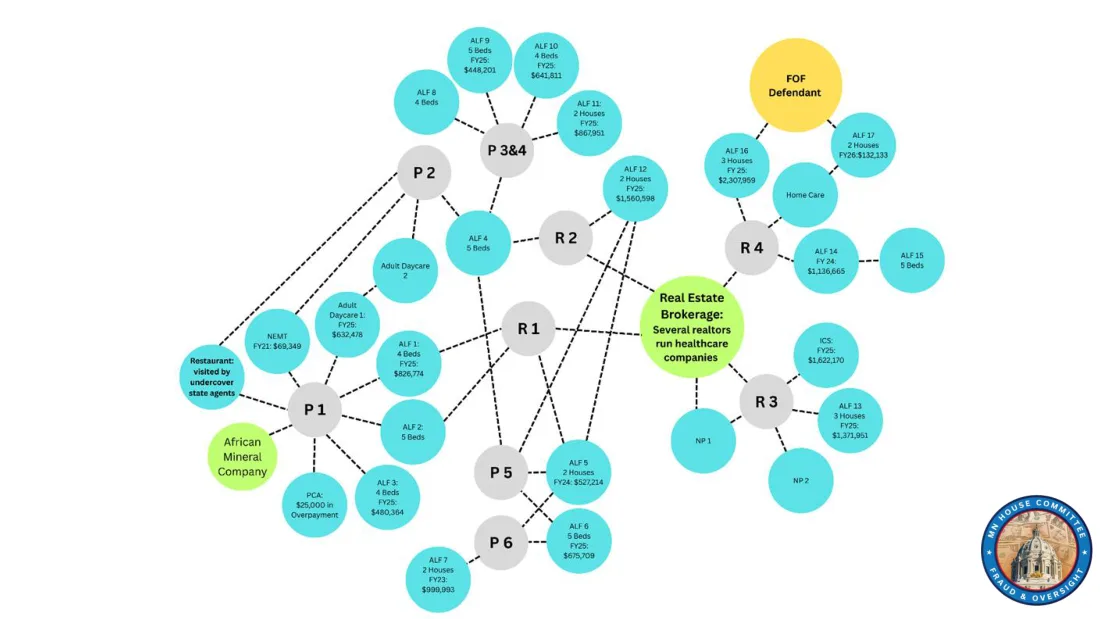
Looking deeper into the ownership of these small ALFs, connections were observed between many providers and other Medicaid funded entities. Chair Robbins presented to the Committee a map of interconnected providers, businesses, and realtors as an example of the actors behind the mass creation of these new taxpayer funded businesses.
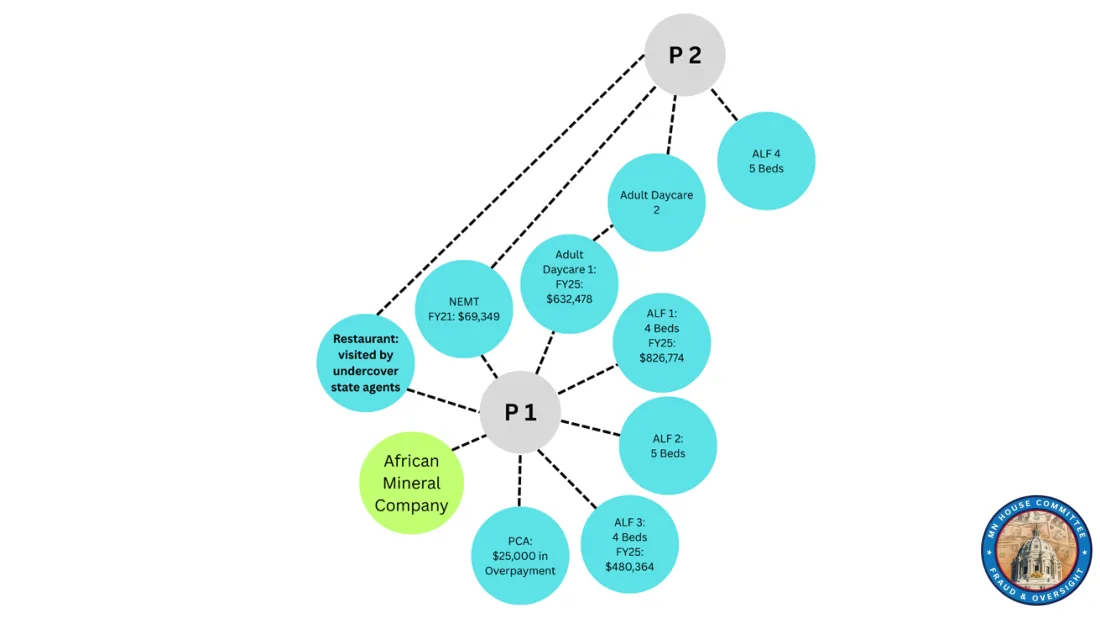
For example, one business owner who recently entered the assisted living space has operated several other taxpayer-funded healthcare entities, has shown a history of non-compliance with their other businesses, and had connections to other suspect providers with similar red flags.
This individual (Person 1 or P1) was initially brought to the Committee’s attention when their Personal Care Attendant (PCA) business could not be found at the location at which it was licensed to operate. In addition to the PCA business, this individual also:
Tanzania.
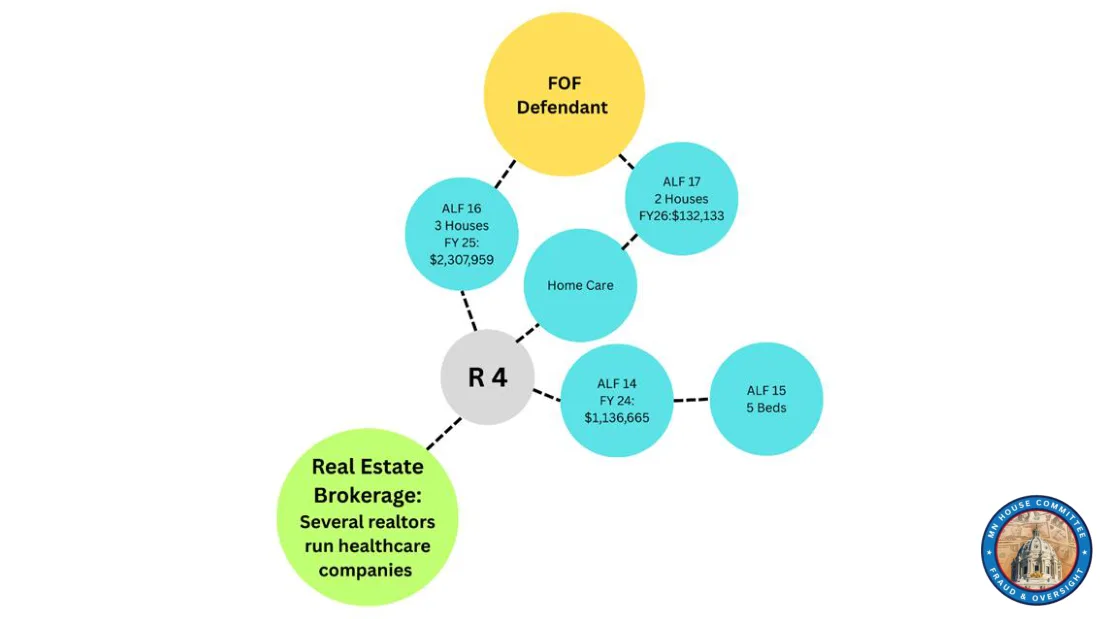
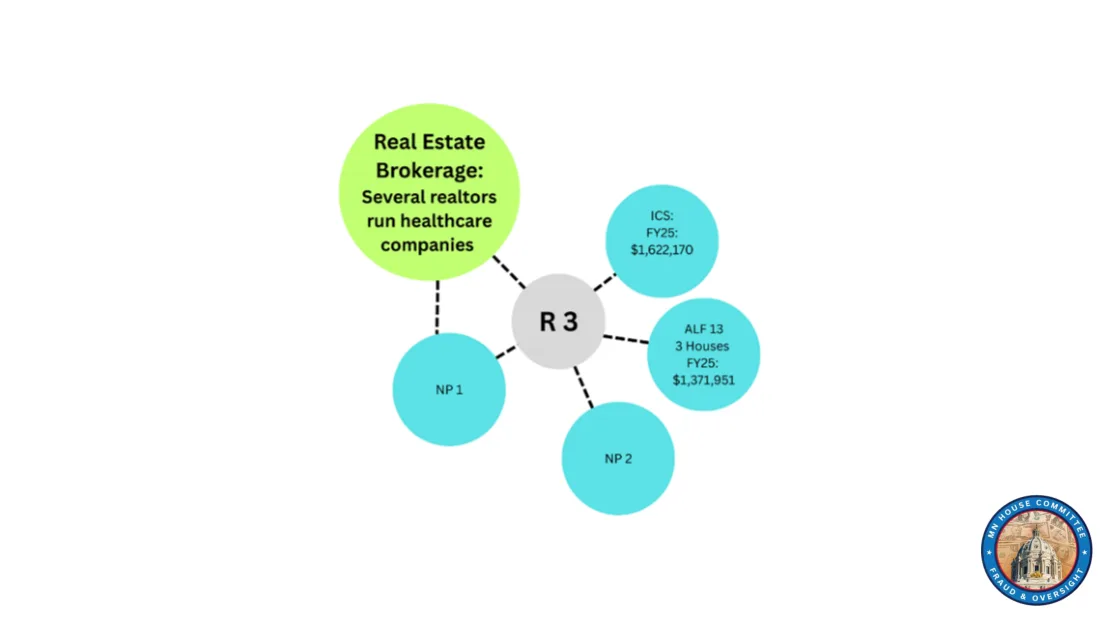
In purchasing property for their assisted living ventures, this individual has used the services of a realtor (R1) affiliated with a metro-based brokerage with many brokers who repeatedly appear as buying agents for individuals purchasing homes to convert into ALFs. Some of these real estate agents, in turn, are also operating their own taxpayer-funded ALFs or other healthcare entities (R3, R4, etc.).
A familiar name surfaced among the business owners in this network from a previous hearing on Integrated Community Supports (ICS). Jama Mohamod (R3), who has allegedly been defrauding Medicaid and the state through his ICS business, also operates three ALFs under his company, A Helping Hand Senior Care Services.
Despite the scrutiny against his ICS business, his ALF continues to operate and receive state payments seemingly uninhibited despite problematic behavior in another service area. Mohamod is also a realtor affiliated with the same real estate firm previously mentioned. He has also founded two non-profits, one of which has received over $1 million in taxpayer funds. The CEO of the real estate firm served on the non-profit’s board, according to the group’s 2017 IRS 990 filing.
Finding: Gandi Mohamed, indicted (at the time of the hearing) in the Feeding Our Future fraud scheme has direct connections to two assisted living businesses.
Through the Committee’s investigation, it was revealed that Gandi Mohamed, indicted on February 5, 2024 in the Feeding Our Future fraud scheme97, owns the properties for two different taxpayer funded assisted living buisnesses. He bought the properties through a realtor and healthcare business owner affiliated with the same real estate firm mentioned in the previous finding.
Gandi Mohamed’s wife owns a company called 1st Attentive Services. This ALF operates on 4 properties. Three of these homes are owned by Gandi Mohamed through the same LLC he used for money laundering in the Feeding Our Future case, GAK Properties. The 4tth home was purchased by his wife following his indictment using a realtor affiliated with the brokerage referred to in the previous finding.
Individuals connected to Mohamed also operate a company called A Caring Living, filed on 5/7/2024, shortly after Mohamed’s indictment. This company is listed as the manager of another home care company operated by the realtor who assisted his wife in the purchase the 4th home for her business.
In September of 2024, approximately 7 months after Mohamed’s indictment, he purchased two more homes. Shortly after, A Caring Living began billing Medicaid for assisted living services provided at Mohamed’s recently purchased homes.
In sum, Gandi Mohamed, an indicted defendant in the Feeding our Future case at the time of the hearing (now convicted) was still buying property he would “rent” to his wife and associates, who would then bill the state for providing services at those properties through the ALF business they owned.
Despite Mohamed’s indictment in the Feeding Our Future scandal, the Department of Human Services claims to have no authority to intervene in the operations of Mohamed’s wife, or of the
97 Deena Winter, “Man Indicted in Feeding Our Future Fraud Has Been Paid $49 Million by DHS Since 2016,” Minnesota Reformer, Feb. 16, 2024.
1 source link on this page
new ALFs created shortly after Mohamed’s indictment by his associates on two homes he purchased using same shell company he has been indicted for using in Feeding Our Future.
In a statement published by News Nation, the agency said:
“DHS cannot withhold payments for a business only based on an indicted individual being a landlord for a property. If the indicted person were an owner or had a role in the operation of a company delivering Medicaid services, DHS would have authority to withhold payment.”98
The Committee does not find this credible. The indicted person clearly had purchased the properties and has relationships with the operators of the companies delivering services at said properties.
In April of 2026, Mohamed pled guilty to fraudulently obtaining $1.4 million. In an article covering the conviction published by Kare 11, Mohamed’s role in the scheme as a “landlord” to associates is described.99 “His family members, led by Ikram Mohamed (sister), who worked for Feeding our Future, claimed to serve millions of meals to children in need at Gandi's buildings on East Lake Street and North Logan Avenue. They'd pay Gandi supposed "rent" at those buildings to launder the money. He's now ordered to pay back that $1.4 million.” Summary: This is exactly why Minnesotans are so fed up! Two different departments have shared authority over ALFs but neither thinks it has oversight responsibility for billing or finances. There has been significant growth in small ALFs because it enabled owners to get around a more significant licensure process, yet no one seems concerned about this incentive. Once again, we find the interconnected web of relationships that enable known fraudsters and their family members and business associates to continue to bilk taxpayers for money – even when they are facing charges in another fraud case. Minnesota taxpayers are tired of the games and excuses. They want agencies to focus finding these interconnected webs and stopping payments as soon as these red flags appear – not wait until millions has gone out the door. It is not rocket science – stop sending taxpayer dollars to known fraudsters and their associates.
98 Rich McHugh, “Minnesota Pays Millions to Assisted Living Facilities Linked to Fraud Defendant,” NewsNation, Dec. 30, 2025. 99 KARE 11 Investigates, “Fraud Suspect Pleads Guilty with Agreement Won’t Face Future Charges,” Apr. 9, 2026.
Context
- ← chapter House Fraud Committee final report: Waste, Fraud, and Abuse in Minnesota
- concerns Integrated Community Supports
- concerns United States v. Bock and others
- concerns CACFP / SFSP meal programs
- concerns Deena Winter
- records the work of Rep. Kristin Robbins