Now playing: Fraud Committee: Medicaid fraud in Minnesota
Source: Minnesota House of Representatives (MNHouseInfo) · watch the original on YouTube. Played here unaltered except as noted on this page; rights remain with the publisher.
The mechanism
How it happened
The House Fraud Committee's report calls it the anatomy of fraud. Read in order, the record shows the same sequence in program after program: a program built to pay first, a warning written down, a warning set aside, and the same people moving to the next program when the last one tightened.
Quoted findings are the House Fraud Committee majority's, each linked to its page in the searchable report. The records under each step are the independent evidence: audits, court orders, prosecutions, testimony.
1Programs built to pay first
New Medicaid waiver services and pandemic-era meal rules let providers enroll easily and bill on their own attestation, with few site visits and no caps. The committee majority says this design is what let the losses grow from one program to many.
“The Walz Administrations Enabled Fraud by Poor Program Design and Weak Controls”
“is what enabled fraud to grow from an estimated $5 - $100 million in the childcare program to billions across multiple Medicaid services”
“the state largely abandoned in-person site visits during the COVID pandemic”
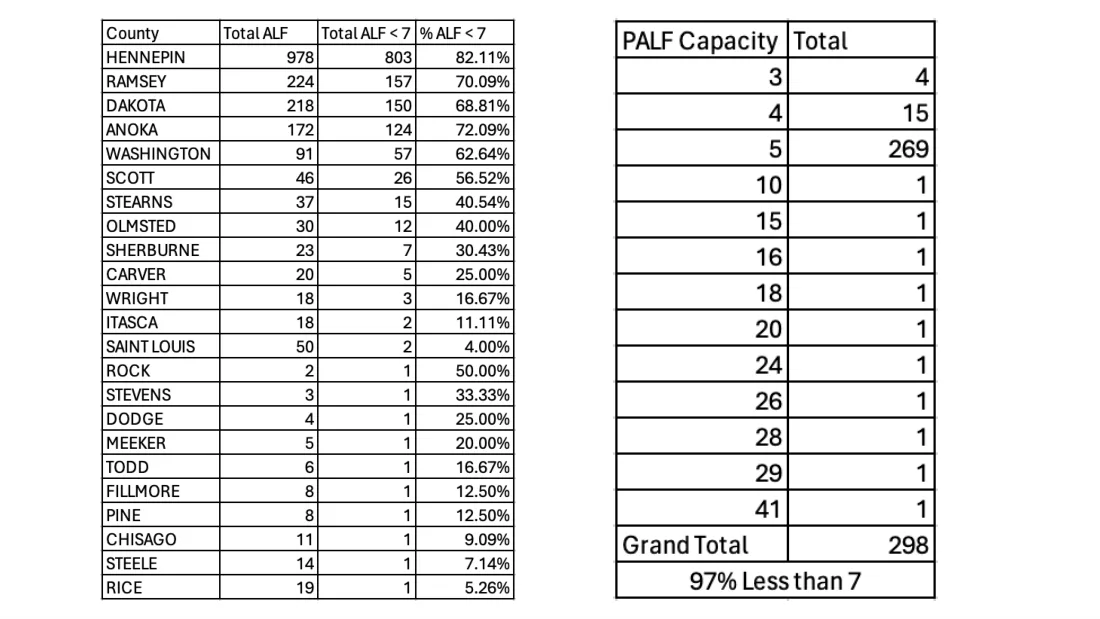
Assisted-living facilities by county and the share under seven beds; provisional licenses by capacity: 298 in all, 97% under seven beds. The report states the same 97% on page 59. 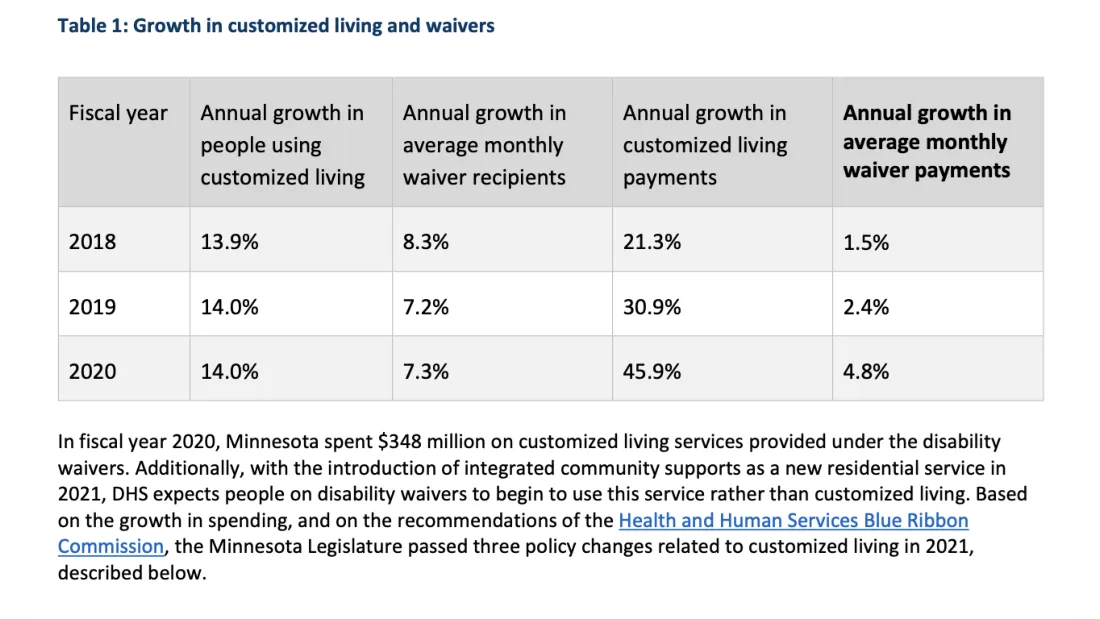
Growth in customized living and waiver payments, fiscal 2018-2020, as shown in the deck. Source: Assisted Living Slides, House Fraud Committee hearing, Dec 17, 2025 (committee document, as presented by Rep. Robbins) · archival copy
2The warnings were written down
A DHS forensics supervisor warned in writing in March 2017; the child-care investigations manager put his estimate in writing in August 2018; the Legislative Auditor reported in 2019. The committee majority found the warnings were impeded and softened on the way up.
“DHS officials impeded criminal investigations and reporting to the Office of Legislative Auditor (OLA)”
“DHS officials in the Dayton Administration attempted to suppress or alter an email from the supervisor of the Childcare Provider Criminal Investigation Unit”
“It appears that after DHS was allowed to review the revised draft, DHS convinced PFM to downplay the amount of money going to fraudulent providers.”
3The unit that was catching it was closed
DHS had a child-care criminal investigations unit with law-enforcement partners and convictions to its name. It was replaced with administrative reviews of overpayments.
“Not long after his departure, the unit was shut down completely, with criminal investigations replaced with administrative investigations for "overpayments."”
“disbanded the criminal investigative unit, banned the BCA from DHS”
4The auditor's reports got no hearings
The report records that committee chairs in the then-DFL House were told not to give the 2019 fraud reports public hearings. The account comes from former Legislative Auditor Jim Nobles.
“House committee chairs had been instructed not to give OLA reports about fraud any public hearings.”
5Warnings answered with accusations
Whistleblowers told the committee they were sidelined or worse, and that raising fraud in particular communities was treated as bias. The committee majority adopted that conclusion.
“the Walz Administration ignored, demoted, and retaliated against whistleblowers, sometimes accusing them of being racists”
“DHS leadership retaliated against and undermined the criminal investigations unit in a number of ways”
- Scott Stillman person
- Jay Swanson person
- Steve Halicki person
6One scheme became the template
The committee traces a line from the child-care cases to Feeding Our Future and from there into the Medicaid waiver programs, with the same playbook each time.
“Feeding Our Future was born out of the CCAP fraud.”
“Feeding our Future created the template and business model for the large-scale fraud schemes that have plagued Minnesota since 2020.”
“childcare fraud morphed into Feeding our Future, which has further expanded into multiple vectors of Medicaid fraud”
“The Committee identified the same basic pattern used by criminals across multiple programs”
7Same people, same addresses
Providers tied to one scheme kept billing in another, and closed businesses reopened at the same address under new names. The report documents the overlap between the meal sites and licensed child-care centers, buildings housing many providers, and a network of assisted-living facilities.
“Among the 323 food sites sponsored by Feeding Our Future, 69 were identified by the Committee as also being CCAP-funded”
“both DHS and DCYF allowed Mahamud to continue billing CCAP uninhibited nearly until her arrest in 2026”
“The Walz Administration has been lax and permissive, allowing indicted fraudsters and their associates to continue stealing from Minnesotans in other programs.”
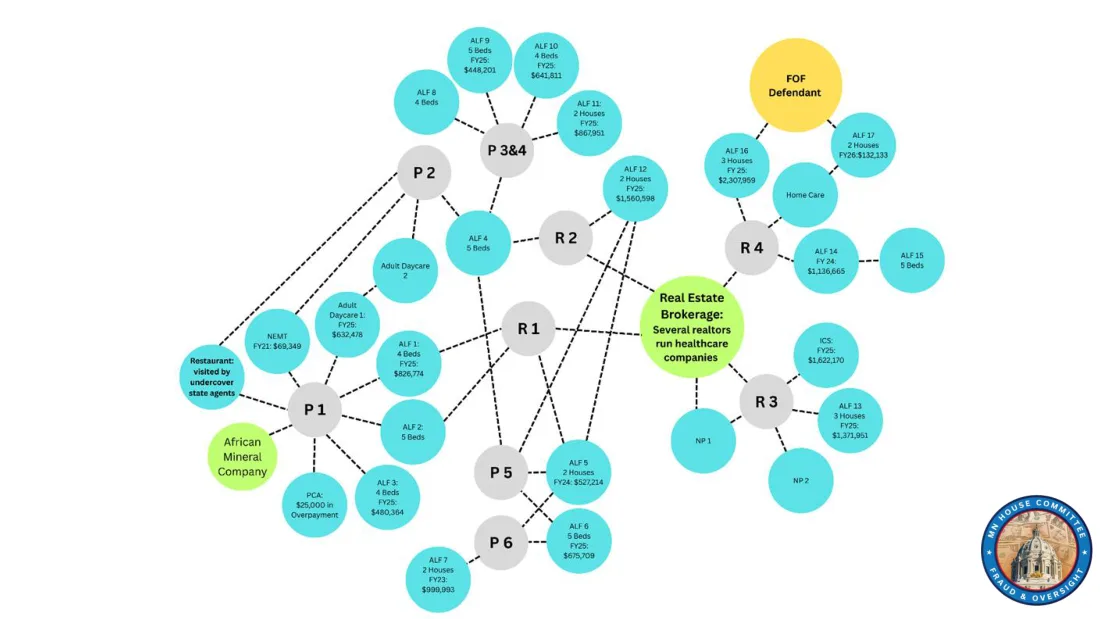
The network as presented: people (P1-P6), realtors (R1-R4), assisted-living houses, adult day centers and other businesses, with state payments by fiscal year. One node is marked as a Feeding Our Future defendant. The committee's slides are anonymized; so is this. Source: Assisted Living Slides, House Fraud Committee hearing, Dec 17, 2025 (committee document, as presented by Rep. Robbins) · archival copy
8The tools existed
Federal rules let a state suspend payment on a credible allegation of fraud and treat programs as high-risk. The court in the Feeding Our Future case never ordered payments resumed. The committee and the Legislative Auditor both found agencies did not use the tools they had.
“In April 2021, a court order required MDE to resume processing applications for meal sites, but never required them to resume payments.”
“The OLA emphasized that MDE did not fully use the oversight tools available to the agency.”
9The scale
The First Assistant U.S. Attorney read the 14 high-risk programs' claims file as half or more fraudulent. When DHS made those providers revalidate in 2026, 61 percent were disenrolled. The report's own dollar totals differ from page to page; see its notes.
“This malfeasance and incompetence has cost Minnesotans $300 million in federal meals fraud and up to $9 billion in Medicaid fraud.”
10What would stop it
The committee majority's recommendations start with an independent Inspector General for the executive branch, a ten-year statute of limitations for fraud, and disclosure of payment withholds.
“prioritized getting as much money out the door as possible, with little regard to protecting taxpayers or vulnerable citizens in need of services”